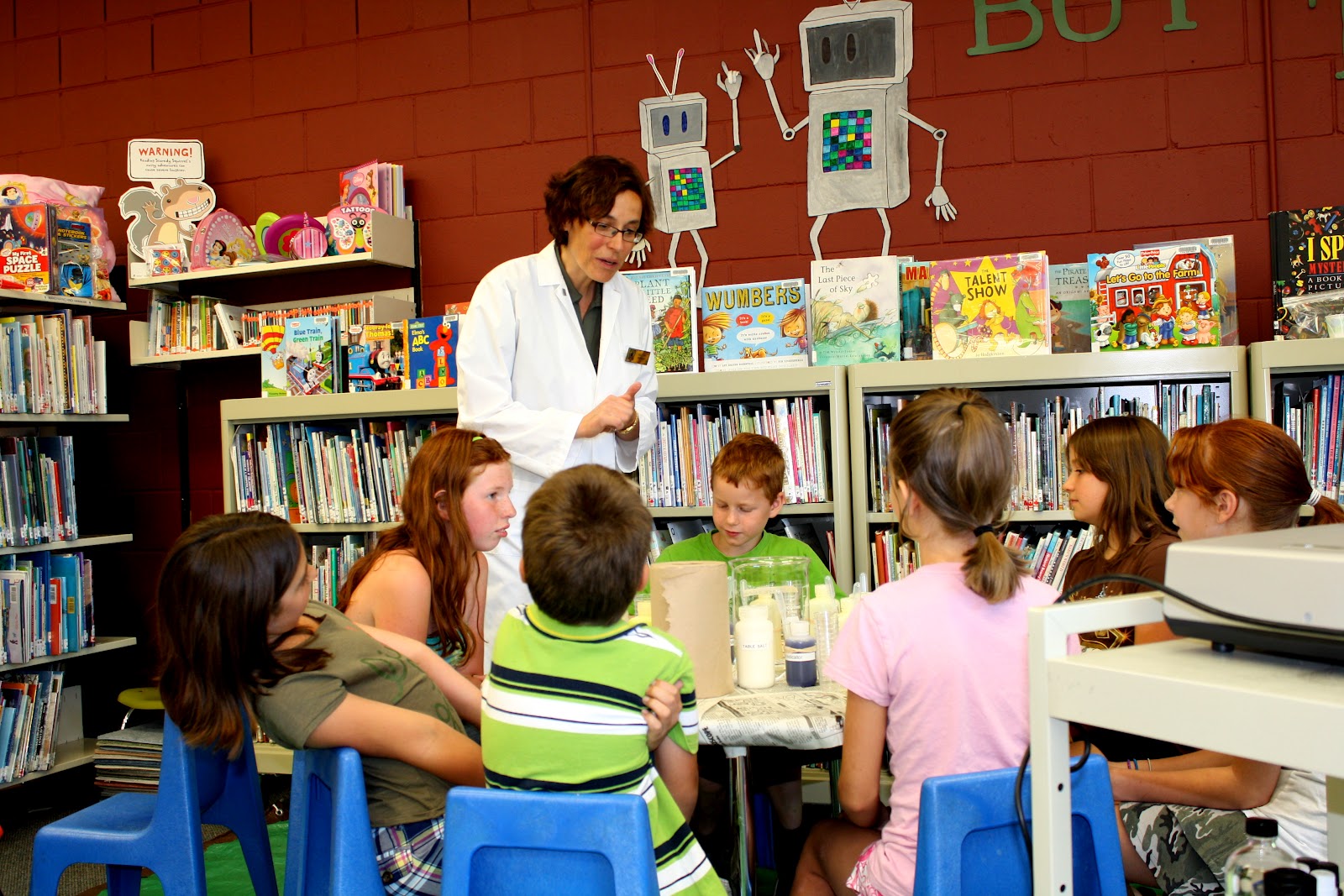
For our 4th Guest Wednesday, we had our friend, Diana from the Columbia Basin Water Smart and she came to us with lots of knowledge about water conservation!!!
She told us a great story about her friend - Wally? - the water smart fish who goes up against the terrible water wasting dragon!! Her art work for her story was beautiful and I think the kids and I really enjoyed the story!
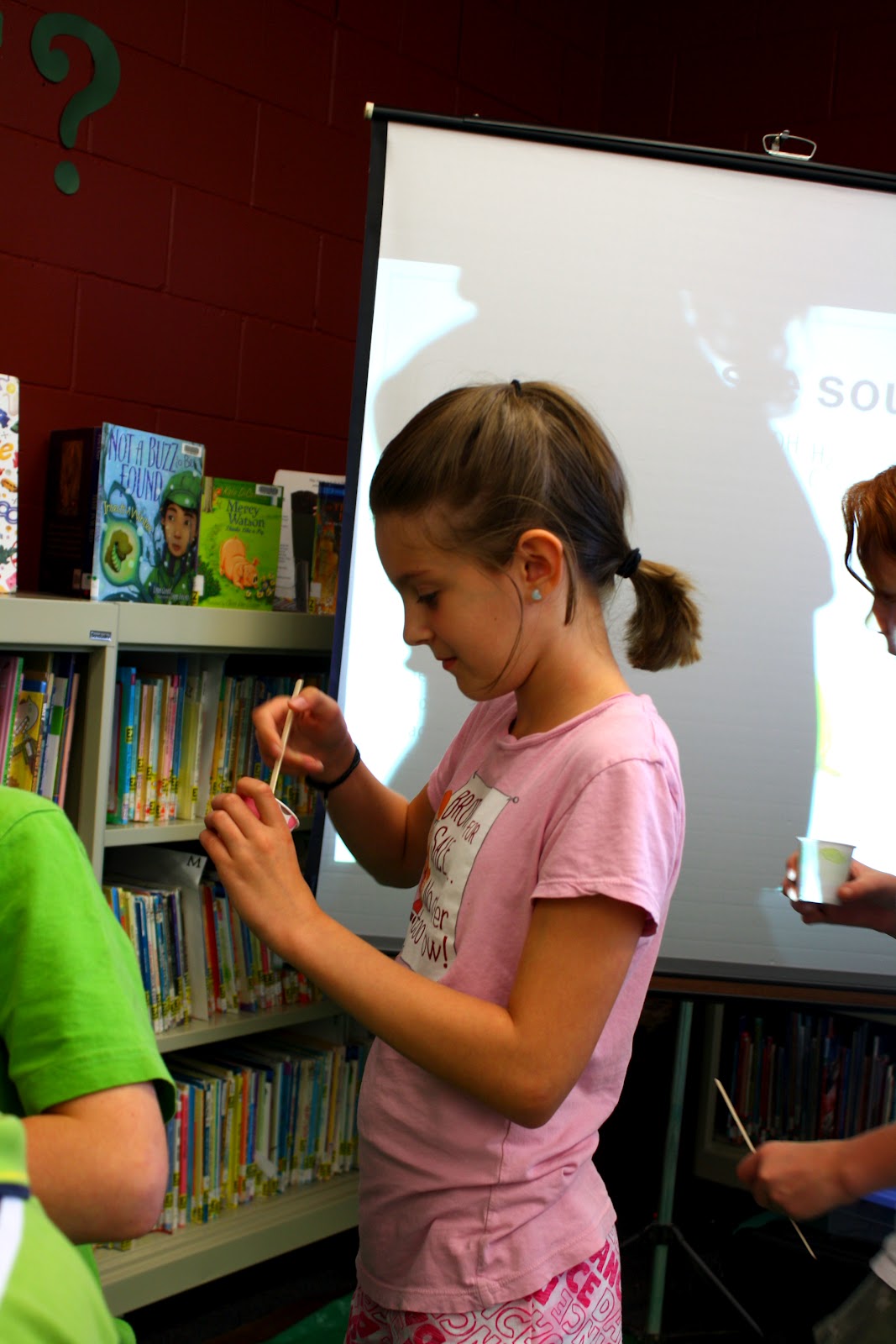
After the story, Diana took the kids to investigate water usage in our bathroom (sorry, no pictures!). We experimented with how much water can be wasted when we don't properly turn off the taps whilst brushing our teeth! We also used food colouring to see if there were any leaks in our library's public toilet (update: there isn't!!!).
After that Diana took out her magical map and we learnt about where our water comes from in the area! We also learned about how water is cleaned and treated before coming into our houses!
After our review of the area's water sources we went outside for some more fun!!
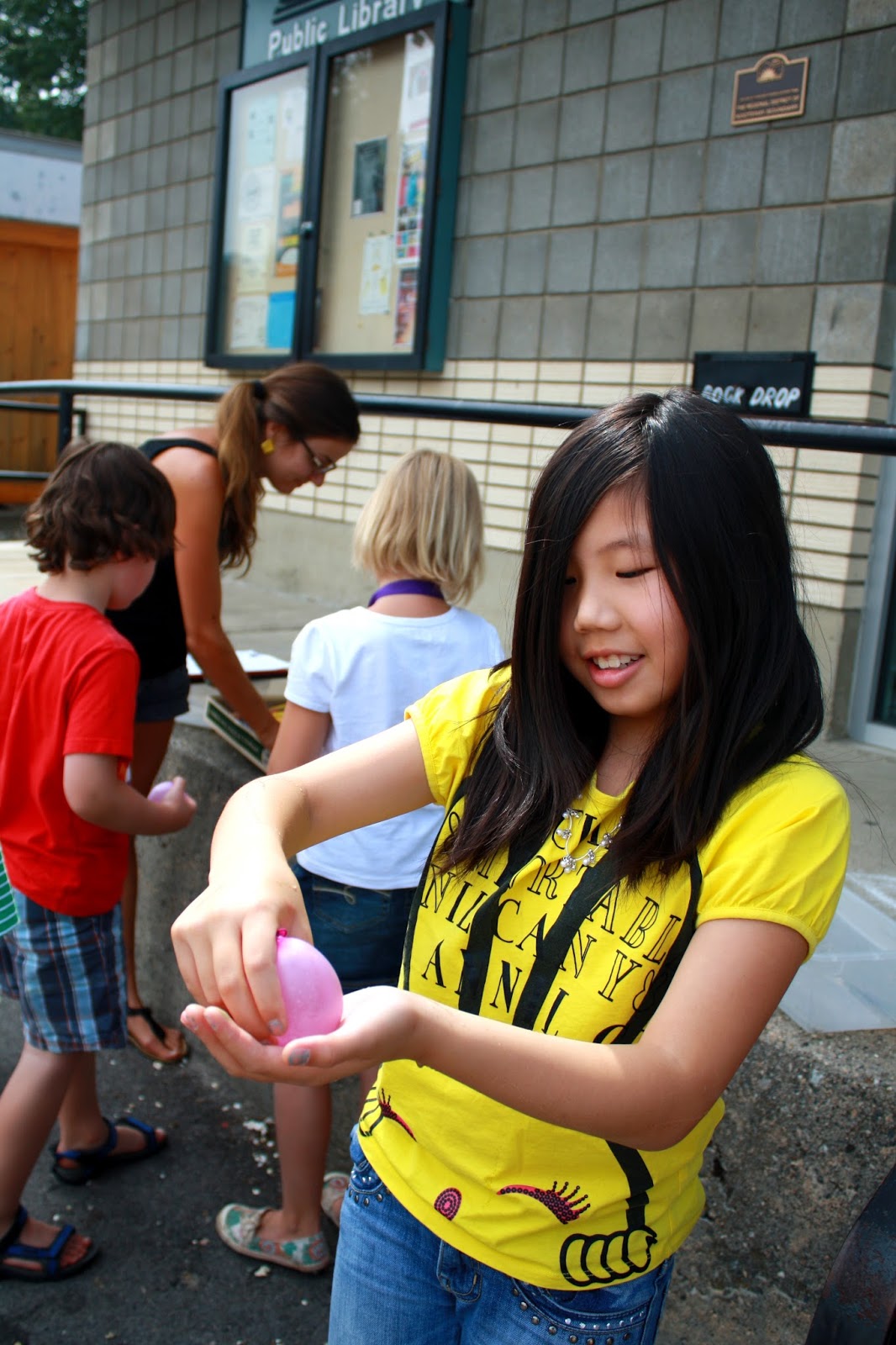
Diana brought with her some water balloons as well! And she also unveiled her amazing juggling skills to us all!!!
We were also joined by our library puppy, Gypsy :)
As a gift to the kids, Diana taught them the basic skill in water balloon juggling and we all tried our best to master the techniques!
We also got to get some face paint!! AWESOME!
It was great fun! We also had time to read some stories and check out some books! Thanks Diana for such a lovely afternoon!
What's a happening here at the library next week you ask!? Well on Wednesday, our Special Guest is Diana from the Columbia Basin Water Smart, and we'll be learning all about where our water comes from and why it's so important to conserve water!!!
Our theme this week - WATER! Good ol' H2O! AW YEAH!
Some of our Young Professors! Studying the capillary action of water! Although in this picture, Cohen looks more like a Young Superhero!
So last week I was so inspired and had enjoyed Science Week so much that I thought ... lets make Science Week a biweekly event. Soooooo..... Science DosWeek? Two Weeks of Science? Biweek sounds weird, like a tiny little bicycle thats too weak to carry anything ... So I just went with Water Week, when in doubt go with some alliteration! It'll lift your spirits ten-fold!
So Water Week commenced on a spritely and well organized pace! We had the joy of the Young Professors on Wednesday morning, who graced us with their presence and sound mind! The yells of H2O!!!! echoed throughout our library and I was thankful that we have our children's program before we open the library to the public! Although I'm sure Marie, our library director, and Nicole were not amused by our ruckus!
Nevertheless, 'twas a fine morning to bask in the miraculousness of water! Last week, during our Guest Wednesday, Allyson shared the Strange ... But True facts about water! She talked about ice floating in water and how used to it we must be, when in fact its CRAZY! Solids usually sink in their liquid form, right? It makes sense! Solid = dense and compactly sorted molecules that move slightly or vibrarte in place and Liquid = flowing spaced out molecules that fill their container. So you would think a solid would sink, but with ice in water, it floats! And thank goodness for that! Allyson explained to us the characteristics of water that lead to H-bonding and the crystalline-like spacing of water as it freezes into ice and how that also lends to the lovely shapes of snowflakes!
She also explained how vital floating ice is to our aquatic ecosystems and the world. With floating ice, lakes generally freeze on the surface, leaving fish underneath, still able to swim around! If water sunk when frozen than the tops of lake would freeze in the winter and sink to the bottom of the lake, wrecking havoc on marine life! Also if this occurred in our oceans, icebergs and frozen masses would sink and inevitability mean that the water levels would rise dramatically leaving little to no exposed land on the earth! Whew, TLDR --> floating ice is a strange, but good thing.
Thank you H-bonds!
So, we started our Wednesday morning talking about water's ability to DEFY GRAVITY!!! - insert Wicked music here - well its not as dramatic as I like make it out to be, but it is quite necessary for plant-life and therefore all life!
With the kids, we talked about watering plants and how their roots absorb the water in the soil, be it from rain or from us watering them! But how is it that water from the soil makes it to the tip-top tops of plants? especially if we think about the tall redwood trees or high reaching trees! The answer? capillary action!
To demonstrate water's gravity defying abilities I place one cup full of blue water atop a pedestal, or in this case a box of food colouring and then beside it on the table I placed an empty cup. To connect the two empty and water filled cups I took a piece of paper towel and placed it into one cup and into the other (see picture below). Almost immediately as I stuck the paper towel into the cup full of water the water slowly began its ascent up the paper towel! --> capillary action!
The capillary action of water in action!
Now, one special characteristic of water is its cohesiveness among its molecules, this is due to water molecules inherent polarity that is due to the electrostatic differences across the negatively charged oxygen atom and positively charged hydrogen atoms, because of this charge separation, water molecules have a positive side and a negative side, resulting in a polar molecule. And as we generally learn in our physics classes when we talk about charges, or if we are scrounging around on plentyoffish looking for our one true love, we know that OPPOSITES ATTRACT! So water molecules have a large affinity to fit together with their positive sides to negative sides of another water molecule, resulting in a high cohesion force (the ability of like substances to cling to each other) among water molecules to stay together.
A fine example of how water beads up due to COHESION! on non-polar material, like leaves.
You can really observe this cohesion of water molecules, when you place some water on wax paper and how immediately the water beads up into sort of spherical droplets rather than spreading out. These sphere-like droplets form from the attraction among the water molecules and results naturally in sphere shapes, since they have the smallest possible surface area to volume ratio.
Now in the terms of our paper towel in the water experiment what we see between our two cups, its this cohesion between the water molecules that allow for a string of water to slowly climb the paper towel. Its this action that also occurs in plants that allows for water to travel up a tree trunk or flower stem!
String of water molecules travelling up
a plant! H-bonds!
So the water in our paper towel moved along the tiny gaps in the fibre of the paper towel, this is due to the adhesive force (the clinging between two dissimilar substances - in this case the paper towel and water) that allows for the water to slowly climb the paper towel, and eventually start to fill the empty cup where the paper towel ends!
Although I didn't go into huge detail about the hydrogen bonding and cohesion/adhesion forces at work, the Young Professors were enthralled in coming back to watch the water climbing in between our activities for the day! Although I must say, the paper towel we used today worked wonders and the water moved quite quickly!
Here are some of the boys checking out the capillary action of water! Huzzah!
Chesney, Elijah, Cody and Cohen (and some parts of Tyler and an eye of Zoe!) looking a bit bewildered by water!
After this we had a quick story time with one of my favourite people, Mr. Hank Green, I took an excerpt from this great Crash Course video about water! In the video, Hank tells the story of an eccentric scientist named Henry Cavendish, who was a scientific genius/madman, who pre-discovered many scientific laws and made groundbreaking discoveries about the composition of water, in a time when people thought water was an element in itself!
Watch the video here in its entirety! The part we watched was from 5:50 - 7:56, although we did indulge ourselves to watch a few more bits and pieces!
Group shot! (From left): Jillian, Serena, Justice, Chase, Alicen, Kyleen and Sara! Our MAD SCIENTISTS!
Oho! A whole week late, here, finally, is my Mad Scientist post for last week's Summer Reading Club meeting! Our theme you ask? SCIENCE! :D
Last week was loads of fun, fresh off from the Guest Wednesday the previous afternoon, with Allyson, lots of the kids were excited to continue our adventures through the world of science!
I also need to thank my friend Teresa! I asked her at the beginning of summer about any cool science-y activities/experiments for kids and she whipped this right out of her memories from Science World! Awesome! Science World is like the Disneyland of science!
Here's a few links to some websites that talk more about this activity!
Here are some pictures of the Mad Scientists enjoying their milk rainbows!
Brothers Justice and Chase!
Misses Kyleen and Serena
A close up on Serena's green milk explosion.
The ladies' table
The boys' table! So spacious!
Here's my demonstration plates! The left is a beautiful representation of diffusion in water and the left is my milk plate, the colours disrupted by a dab of soap!
We then moved on to talking about different states of matter: solids, liquids and gases! We talked about the differences between the three states and then I posed a demonstration for the kids! I showed a tank of water and we all were familiar with its movements: how it fills the container its placed in, how it reacts to outside forces, how it bends and flows and its viscosity - a liquid's measured thickness or resistance to flow in a fluid. It is a fine example of a newtonian fluid! Newton proposed that a liquid's viscosity is directly related to temperature, and that is what we can observe in newtonian fluids! For example, honey and ketchup are both thick liquids that flow slowly. But when you heat honey up it flows more easily and therefore cold honey is more viscous than warm honey!
After investigating or tub of water, I brought out my tub of cornstarch mixture! It also goes my the name oobleck and is made of 1.5 parts cornstarch to 1 part water, and mixed up very well!
This cornstarch mixture is a strange and fun way to learn about non-newtonian fluids! These fluids act strange in that they act like a solid at times and a liquid at other times! Where a newtonian fluid, like water, moves and flows away when an outside forces pushes against it, a non-newtonian fluid instead of moving, solidifies and stiffens like a solid! Here the molecules of the mixture react to the outside pressure and move closer together, almost like moving into a crystalline structure! And then almost immediately after the pressure is taken away, the non-newtonian fluid goes back to flowing like a liquid! This is a great example of a non-newtonian fluid, because here the fluid changes its viscosity when stress or a force is applied! - not when heat is applied, as was the case with a newtonian fluid.
For me, the best way to demonstrate this is when you punch a tub full of the oobleck - as I showed the kids! I (gently) punched my tub of water to show the water moves and flows away, while causing a bit of a splash. Then I punched the oobleck and rather than my fist going through the liquid it bounced of a rigid surface!
Before I unleashed the Mad Scientists into the ooze and globs of cornstarch, I asked them to watch a video that explains oobleck very well! One of my all-time favourite authors, John Green, is an avid YouTuber and started a vlogchannel with his brother Hank Green.
You can check out a couple of John's books out here at the library: "Paper Towns" and a short story in the compilation book "Geektastic".
Anyways, I love the Green Brothers, they are great people. And John's brother, Hank, is an accomplished environmental science blogger. Nowadays, John and Hank have started a new creation of online education videos that are both entertaining and extremely educational! So for the Mad Scientists we watched one of Hank's videos talking about non-newtonian fluids!
I'll post it here if you'd like to take a look at it!
The kids really liked this video, I think the best thing I heard all week came from Justice who said "That guy is even better than Bill Nye the Science Guy!" ... Now I don't know if Hank is BETTER than good ol' Bill but they are definitely two amazing and awesome people!
This week at the library Rhonda had a airplane in the sky day with the Little Einsteins!
Tomorrow we will continue our Science Exploration with the Young Professors! We are going to be observing the Strange ... But True? behaviour of water!!! WATER WEEK!
Tomorrow also means another Guest Wednesday! I'm excited for this one! Here's the poster! Hope I see you tomorrow!
Also! Here are the winners of the draw for last week! Congrats! And keep on reading you guys! Make sure to bring your reading records into the library so we can tally up your ballots!
Oh goodness me! I'm back at the library this lovely Tuesday morning and I guess I was too ambitious in thinking I could do some more posts over the weekend! Let's just say that my sister's bachelorette weekend was packed full of activity! I can now no longer move my arms properly, white water rafting seems so have awaken my untrained muscles in a very uncomfortable way! But nevertheless I am now very excited for her wedding in September!
But let's backtrack now! Last week was so fun and filled with science! So here is the story of our Guest Wednesday last week, where we hosted the lovely and intelligent Allyson Perrott! Enjoy, cause I took lots of pictures!
Science Slide Shooooooow!
So after our busy Wednesday morning with the Young Professors! Allyson came into the library - which was covered in food colouring and slime - and set up her many goodies from Selkirk College. She prepared a slide show, along with 4 different fun science stations for us to go through!
To start we introduced Allyson to all the kids and then we moved on to listen to Allyson talk about chemistry! We talked about how the word "chemicals" generally gives us an uneasy feeling when we hear about it on the news or in conversation! But in reality, we learned that chemicals are basically EVERYTHING around us!!! So they aren't really bad all the time!
The safe way of smelling lab smells!
And then Allyson delved into the many Strange ... But True? factoids about science and chemistry! She told us about water, and how while it is a very well known and essential chemical in our world it is also very strange!!! We learned that water has a funny characteristic that separates it from other materials! Water, when in its frozen state floats in its solid state! That's why ice in our water floats! But it is quite odd, since generally speaking a solid is more densely compacted and has its molecules arranged closely together! But with water, the H2O molecules are actually spaced out and form a sort of crystalline shape do to the polarity of water and these bonds are called H-bonds! It's also the reason for the Strange ... But True? shapes of snowflakes!
Allyson also talked about smells! And how the structure of a molecule and its shape works in determining the smell that is translated to our brains by our nose! We sampled different smells and used the special scientist smelling technique that all the kids mastered in a flash!
A beaker full of water! ... or rather full of water molecule models! :)
Allyson shared some candy, sweets and chocolates as well to match the smells that we smelled! AWESOME! She also eluded to the subtle differences in configuration in certain molecules that give each substance its own unique smell! (queue flashback to my classes at Selkirk! It was like a pop quiz for me!)
After her presentation, Allyson led us through her first planned activity, where we took ordinary glass vials and using some chemicals and energy (shaking!) we ended up with a reaction that coated our vial in silver!
Station #1 Silver Vial Coating! From right to left is the process of the before and after of our experiment!
Here are the pictures of the kids getting there flasks! Shaking up their vial and revealing their new silvered vial! Allyson told us that this procedure is similar to how mirrors are made! Cool!
Sydney and Serena shacking up their vial!
Getting their vials and adding a dropper full of Silver Nitrate and adding 10 drops of sugar solution!
Cody with a before and after of the vials!
Our next station was the SLIME station!!! Allyson had set up two burettes filled with borax and another solution. Everyone was given a cup to add food colouring into and then added the measured out amounts of borax and solution! Everyone was given a stir stick and away they went! We got slime to take home!
Station #2 Slime! I absolutely love this photo of Miss Jillian! with Tyler and Alicen as well!
Such good listeners!
SLIME!
Tyler and Cody playing with their slime!
Alicen with her slime!
Sydney!
Slime time!
Serena with her slime!
And lastly to finish off our exciting and awesome Guest Wednesday, Allyson set up an Acid Base Table! Here on our table we had bottles of red cabbage juice (which works as a great acid/base indicator!). When the red cabbage juice is combined with an acid, the colour of the mixture goes from red to a pinkish colour, whereas in a base the colour changes to a greenish blue or yellow! Around the table was an array of different examples of acids and bases that the kids could test out with the red cabbage juice!
Station #3 Acid and Base Indictator
Allyson gave everyone a little plastic beaker cup where they could mix up their solutions! And in the middle of the table we had a great big waste beaker to dump everything into after the experiment! The kids really enjoyed this! Especially when Cody discovered the baking soda and vinegar! EXPLOSIONS!
Allyson with the kids at the acid/base table!
If you'd like to recreate this experiment at home here's a link to the recipe Allyson gave to us for making your very own red cabbage juice indicator! http://www.vickicobb.com/scienceyoueat.html
Shoot! i forgot to take a group picture of the kids with Allyson :( But this one is the closest to a group picture as I got!
The scientists hard at work!
Station #4 Molecule/Atom Model Kits!
Whew! It was a long day! And we made quite the mess! But the kids (and Rhonda and I!) had a blast! We learnt so much about chemistry and got to do a lot of hands on activities! The kids went home with their new silvered vials and slimy slime, along with a recipe for red cabbage juice! Allyson was so generous with her time and materials as she brought a whole lab to the library! Thank you so much Allyson!
Come to the library this week tomorrow! Wednesday, August 1st for our Guest Wednesday with David DeRosa of Cominco! He will be talking to us about the animals and bugs that reside in Beaver Creek!
Thank you again Allyson! We had such a great time last week! So much so that I am mixing up our themes for the Summer Reading Club and continuing with another week of SCIENCE! Hurray! This week we are exploring the craziness and essential-ness of water, good ol' H2O!